

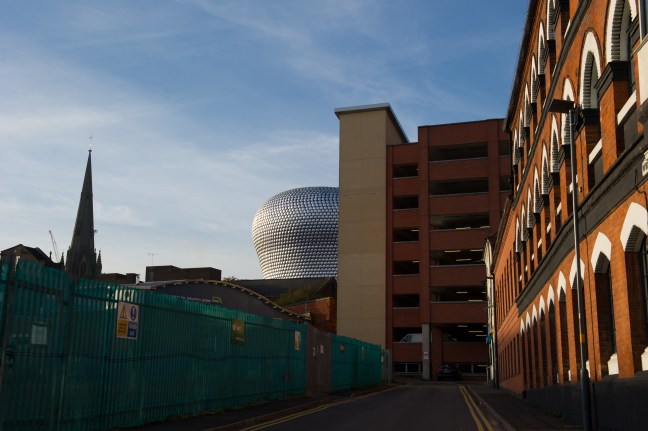
I love Birmingham. I moved here begrudgingly as a child, when my dad got a new job and apart from the odd spell living elsewhere, I have lived here for the best part of my life. I wasn’t born here but I do feel more Brummie than anything else.
Birmingham is a wonderfully diverse, beautiful and fascinating city but, perhaps like any city or town in the UK, it is a city with two faces.
It is a city of Michelin star restaurants, independent coffee houses and cocktail bars. It is the home of the Bull Ring, Grand Central, and Cadbury’s Chocolate, the birth place of Duran Duran, Black Sabbath and, my personal favourite, UB40.
It is a city of around 1 million people, the youngest city in Europe and incredibly diverse, being described in 2013 as “Superdiverse” by the Institute for Research into Superdiversity (IRIS). Their research found that there were people from 187 different nationalities who had found a home in Birmingham. Apparently Birmingham has more green spaces than any other city in Europe, and more canals than Venice. It is a city of culture and hosts a variety of museums and galleries, theatre productions, and live music festivals and concerts. It is a city of possibility and opportunity, of business and commerce, and entrepreneurialism. It is all these things and many more but it is a city with two faces and its other face is not nearly quite so pretty.
Its other face is cruel and crushing and its hands wrap themselves around the throat of vulnerable people squeezing the life and hope out of them.
You don’t have to look very far to see its effects. It is found in the foodbanks across the city as people, many of whom are working but are just not earning enough, have to they forgo their pride in order to eat.
Families whose homes are half empty, who have to make decisions about heating or eating, and who can’t afford curtains and carpets.
People who have been so entrenched in abuse and domestic violence that when they finally find the courage and capacity to leave they find themselves with nothing and so fear morphs from one thing to another.
People who were born outside of the UK and who have lived here for more years than they can remember but now post referendum find themselves on the end of blatant public racism and xenophobia.
People who for a whole host of different reasons, have lost everything and everyone that was important to them, medicating their pain with whatever drug they can and racking their bodies with cravings that scream to be fed.
People who live alone and speak to practically no one, whose company is the cast of Coronation St and Eastenders, and who in equal measure both long for and fear a knock on the door.
People looking and longing for work, for a sense of meaning and usefulness but who time and time again face rejection.
People whose illness prevents them from doing all that they long to do, all that they used to do, all that they once felt fulfilled and formed by, but the memories of which now make them feel empty and void.
People who have fled war and persecution only to be greeted with hostility, suspicion and a soul destroying asylum system.
People who just long for someone to talk to, someone to listen, someone who genuinely cares about them.
These are the just some of the lived experiences of people living here in Birmingham, in this city of great opportunity there is also great hardship and real need.
I work with churches and projects around the city who on a day to day basis are trying to support some of the people in our city who face such difficulties. I am really encouraged by those people and organisations, many of whom are doing so much with so little and often at great personal cost. As the visible numbers of people sleeping rough on our streets continues to increase I find myself at times feeling overwhelmed by it all but I am reminded of something my friend Tim Evans said a few months ago – “we have to keep believing that something can be done, that change can happen and that we can be part of it”.
We do indeed have to keep believing, and trying to find ways to play our part in helping change to happen. There is certainly much to build on in Birmingham and so many people committed to making ours a city where people don’t just survive but truly flourish.
I was reminded recently that Birmingham is a city that aspires to flourishing neighbourhoods that are “clean, safe and generous” and that generosity has very recently been beautifully demonstrated by so many people during Birmingham’s week of Kindness, a campaign that encouraged the people of Birmingham to “do something kind today”. I feel proud to live in a city whose response to racism and xenophobia was to start a campaign of kindness encouraging people to “Love Your Neighbour” – I have loved driving round the city and discovering the bright orange Love Your Neighbour banners and posters on school gates, university railings, churches, mosques, synagogues, community centres, shop windows and a whole host of other places.
I have been reflecting a lot recently on Jeremiah 29, in particular verse 7
“But seek the welfare of the city where I have sent you into exile, and pray to the LORD on its behalf, for in its welfare you will find your welfare”. Jeremiah 29:7 (NRSV)
Written to the people of Israel at a time of exile, it is a message that I think is as true today for churches and Christians living in Birmingham as it was for the exiled people of Israel in Babylon.
In this passage the prophet Jeremiah gives the people two instructions about the city they found themselves in – they are to seek its welfare and to pray for it.
Now I am no theologian but I understand from those who are that the word translated here as “welfare”, and which in other versions of the bible is translated “peace” (CEV) or “peace and prosperity” (NIV) or “wellbeing” (NLV), is actually the Hebrew word “Shalom”. Shalom is a deeply rich word which I won’t be able to do justice to, but it encapsulates within it peace, wellbeing and flourishing life. So when Jeremiah called the people of Israel to seek the Shalom of the city, he was calling them to seek all that and more, and not just to seek it for themselves but to seek it for all those who lived amongst them in Babylon – their own Shalom, their own well-being, was bound up with those living around them. There is something for me in this passage that hints at the common bonds of humanity, articulated in Southern African phrase ‘Ubuntu’ – a belief that all humanity is connected to one another, and that our well-being is only truly realised alongside the well-being of others.
So this passage leads me to a couple of questions; questions for me to wrestle with as an individual living out my faith here in Birmingham, but I hope also questions for the church to consider and wrestle with too. I do not profess to have answers but these are my questions and musings to date.
How do we seek the welfare of the city? Seeking is not passive it is active, and it is not a singular action but a pattern, a habit or a rhythm of purposeful discovery, discovery that we then somehow act upon, that changes our behaviour or leads us to purposeful action. So I think that part of what it means to seek the welfare of the city is to commit to a pattern of discovering more about the city, more about the people who live alongside us, particularly those whose life experiences are different from our own, and taking the time to genuinely listen to one another. Listening and discovering what is already going on, what others are already doing to seek the welfare of the city, and perhaps considering how we might join in with them.
What does it mean to pray to the Lord on its behalf? Prayer is not my specialist subject by any means, but I do wrestle with what it means to pray meaningfully for Birmingham. My limited experience is that praying meaningfully is often about having my heart broken for something or someone, and that that somehow enables me to glimpse something of the pain of that situation. I have a bit of a bugbear about intercession in the life of the church. I wonder about the place for lament, for weeping about injustice and for grieving before God for the things that aren’t as they should be. My experience is that only a few churches really take this seriously – but I hope that that might change.
As part of my job I facilitate a process with churches called Know Your Church Know Your Neighbourhood – it does what it says on the tin and is a process that helps churches have a better understanding of themselves, of the neighbourhood around them, and it enables them to think about how they might more effectively contribute to the flourishing of that neighbourhood. One of my favourite activities as part of this process is a reflective prayer walk with God; we ask everyone involved to take a walk around their area asking God to show them the neighbourhood with fresh eyes. They are given some guidance about things they might want to look for – signs of need, signs of change, signs of faith and signs of hope. It is amazing what people discover, what they see that they hadn’t really noticed or thought about before, and it often leads into a deeper connection and concern for that place and the people in it. I think that perhaps this is one way of both “seeking its welfare” and “praying to Lord on its behalf”.
So I end where I began, because I really do love Birmingham. I know there are many people across the city who feel the same, many of them are people of faith whose faith propels them to hope for more for this city and its people, and who participate in seeking its welfare – to seeking the Shalom of the city.
I hope this movement of people seeking and praying continues to grow, at such an uncertain time in our country’s history it really needs to. In all sorts of ways, often quite small ones, we can play our part in making our city a place where people can flourish. I hope for this especially in the places where there is currently the most need, and I look for a day when instead of two faces, Birmingham has only one face and it’s a face that truly shines.
Photo by Ian Cuthbert
 Sarah Turner's Blog
This is great Sarah. I’ve met a lot of people over the past few years who I’d consider to be an expert in prayer. Without exception they disagree with my consideration! The more I’ve heard you talk about prayer and revealed your concern for the poorest, the most lost and the most broken the more I think you may belong amidst this fine collection of people. I’d see this blog post as a prayer but I also think there is a deeper prayer in your heart that cannot be confined to an eloquent response but tumbles out in tears, sighs, frustration and – crucially – mobilisation that reflects God’s heart in a more acute and intimate way than you know. Cheering you on 🙂
LikeLike
Thank you Andy.😀
LikeLike
Lovely Sarah. You’re an inspiration x
LikeLike